Pick your burner by menu. If your weekend trips involve cast-iron skillets, eggs, bacon, and feeding four people out of the back of a truck, a twin-burner propane camp stove earns its spot in your cargo box. If your camp plan requires hiking two miles past the trailhead, boiling water for dehydrated rations, and carrying your gear on your spine, pack an upright or remote-canister isobutane unit. Everything else is compromise.
The divide comes down to mass against control. A standard two-burner camp stove weighs roughly ten to twelve pounds dry, burns heavy one-pound liquid propane bottles, and provides a wide, stable cooking platform. A micro canister stove weighs under three ounces, nests inside an aluminum cookpot, runs on mixed-fuel Lindal-valve canisters, and struggles under heavy frying pans. Look closely at fuel weights, boil mechanics, wind drag, and valve architecture before loading your pack.
Weight Penalties: Total Packed Systems Compared
Dry stove weight tells half the story. Field calculations require the entire system: burner housing, wind guards, fuel canisters, adapters, cookwear, and carrying cases. A standard two-burner suitcase stove, such as a Camp Chef or Coleman Classic, clocks in at 9.5 to 12.2 pounds without fuel. Each standard green one-pound propane cylinder brings an empty bottle weight of roughly 14 ounces plus 16 ounces of fuel, hitting 1.87 pounds per cylinder on the scale. Running two burners for three meals across two days requires two cylinders, pushing total kitchen ballast past 15 pounds before adding pans.
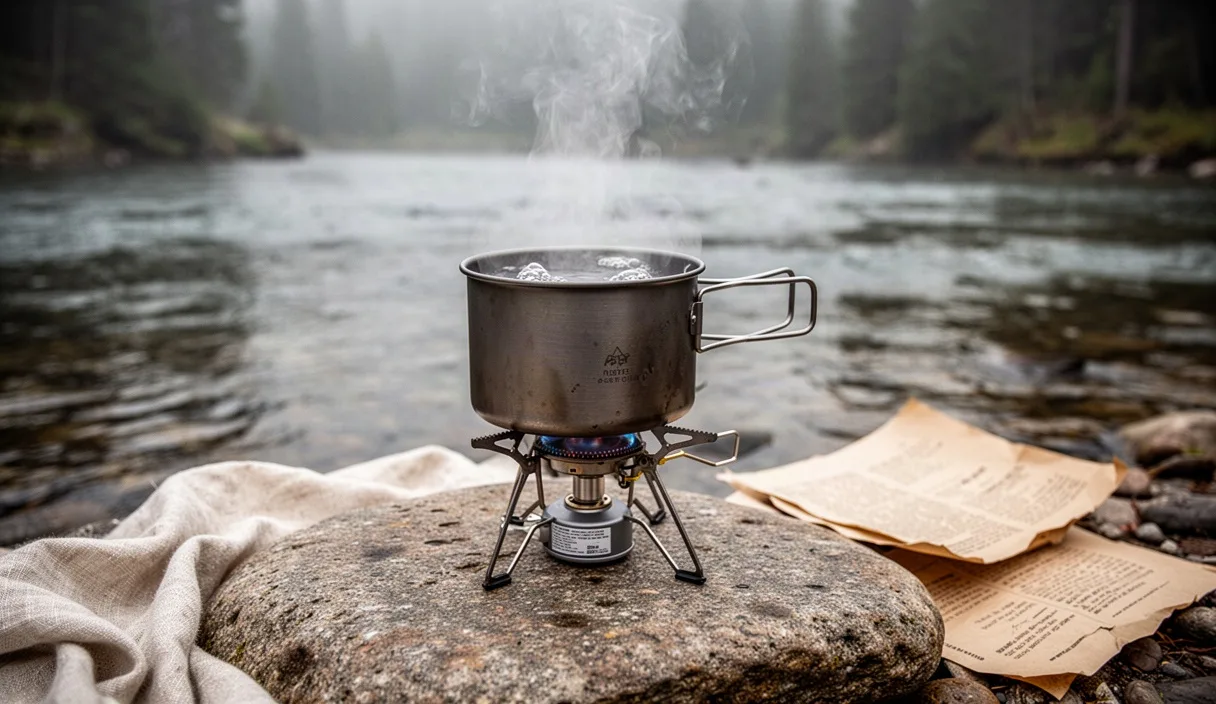
Compact canister systems use a different scale. An ultralight screw-on canister burner weighs between 2.6 and 4.2 ounces. A 230-gram (8.1-ounce) net isobutane/propane mixed canister weighs 13.4 ounces full. Pairing the burner with a 1.2-liter hard-anodized aluminum pot brings the packed kitchen system to 1.45 pounds. Even if you step up to an inverted remote-canister burner with wide pot supports and an external preheat tube, the stove unit weighs 11 to 14 ounces, keeping your total base kitchen weight below 2.5 pounds.
| System Component | Suitcase Two-Burner System | Standard Screw-On Canister | Inverted Remote Canister |
|---|---|---|---|
| Burner Unit Weight | 10.4 lbs (166 oz) | 0.17 lbs (2.7 oz) | 0.72 lbs (11.5 oz) |
| Fuel Container (Full) | 3.74 lbs (60 oz, 2 bottles) | 0.84 lbs (13.4 oz, 1 can) | 0.84 lbs (13.4 oz, 1 can) |
| Compatible Cookware | 4.2 lbs (10-inch skillet + pot) | 0.65 lbs (1.2L pot) | 1.4 lbs (8-inch pan + pot) |
| Total Field Carry | 18.34 lbs | 1.66 lbs | 2.96 lbs |
Carrying that 18-pound kitchen beyond fifty yards from a tailgate creates fatigue. Stacking that mass into a walk-in site or a pack raft destroys weight distribution. Conversely, placing an eight-pound Dutch oven on a 2.7-ounce titanium canister burner shears the valve threads or tips boiling oil into the dirt. Match stove hardware to your haul limit.
Boil Times in 15-Knot Crosswinds
Wind ruins burner efficiency faster than cold ambient temperatures. A 15-knot breeze strips the boundary layer of heat from the bottom of your pot, increases fuel consumption by up to 65 percent, and extends boil times drastically. Open-flame canister burners with exposed burner heads suffer immediate flame deflection in moderate gusts. A standard upright stove taking 3 minutes and 40 seconds to boil a half-liter of water inside a garage will stretch past 9 minutes in an open 15-knot crosswind, or blow out entirely.
Two-burner suitcase stoves address wind via integrated steel baffles. The lid locks open to form a rear wind barrier, while folding side wings shield the cooking grate from the left and right. The large 3-inch to 4-inch burner heads generate 10,000 to 20,000 BTUs of thermal energy per burner. That brute thermal output overcomes ambient cooling, keeping two-cup boil times around 5 minutes and 15 seconds under sustained 15-knot air movement without extra accessory shields.
To keep an upright canister burner running in high winds, use these exact field tactics:
- Position the stove inside a natural windbreak: behind a downed log, in a dry stream cut, or behind a locked cargo container.
- Avoid wrapping a full-height aluminum windscreen tight around an upright canister. Reflecting radiant heat back into the disposable isobutane tank raises internal pressure to dangerous levels.
- Deploy an integrated heat-exchanger cookpot that features deep baffles underneath the rim. These fins capture diverted heat and block wind shear across the burner face.
- Switch to a remote-canister stove if using a 360-degree aluminum foil windscreen. Keeping the fuel canister 12 inches away from the protected burner base prevents catastrophic tank overheating.
Field data collected at 45 degrees Fahrenheit shows the real impact of wind on total fuel volume. In calm air, an 8-ounce isobutane canister delivers roughly 14 boils of 500 milliliters. In an unshielded 15-knot wind, that number drops to 5 boils before the canister drops below operating pressure. If your weekend camp sits on an exposed ridgeline or an open beach, physical wind protection matters more than manufacturer BTU ratings.
Simmer Control for Skillet Cooking
Boiling water requires raw output; actual camp cooking requires precise low-flame adjustment. Standard needle valves on small backpacking burners are engineered to throttle narrow streams of gas into high-pressure jets. The distance between a rolling boil and flame extinction on a micro burner is often less than a two-millimeter turn of the wire valve. This concentrates heat into a circle two inches wide, scorching eggs, burning pancake centers, and leaving pan edges stone cold.
Suitcase two-burner stoves utilize wide cast or stamped burner plates that distribute flames over an area 4 to 5 inches across. Their rotary control knobs travel 180 to 270 degrees from off to maximum output. This wide mechanical sweep lets you set a true low simmer: maintaining 220 to 275 degrees Fahrenheit across the surface of a 10-inch steel or cast-iron skillet without flaring or cutting out. You can sweat onions, slowly braise sausage, or hold warm sauce while working on the second burner.
Cooking real food on a single upright canister stove demands specific adjustments:
- Fit an aluminum flame-diffuser plate over the burner head to spread the localized heat column outward.
- Swap thin titanium cookware for hard-anodized aluminum or copper-bottom steel; titanium has poor thermal conductivity and forms instant hot spots.
- Adjust your fuel valve while watching the flame under low ambient light. Listen for the hissing threshold where the flame begins to flutter, then advance the throttle forward one millimeter.
- Maintain constant pan movement. Slide the skillet across the burner supports continuously to distribute heat evenly across the base of your food.
If your weekend camp meals center on one-pot rehydration, deep simmer control is a secondary metric. If your weekend involves fresh meats, scrambled eggs, flatbreads, or dual-course meals, attempting to regulate low heat on an upright backpacking stove turns food prep into a high-stress chore.
Sub-Freezing Fuel Depressurization Issues
Fuel chemistry dictates cold-weather performance. Standard green propane bottles contain liquid propane, which has a boiling point of -44 degrees Fahrenheit. Propane maintains sufficient vapor pressure to feed a stove burner in almost any lower-48 winter camping scenario. Even at 10 degrees Fahrenheit, a two-burner stove running off a one-pound cylinder lights instantly, holds strong line pressure, and delivers full flame without warming tricks.
Backpacking canister fuel is a blend: typically 70 percent to 80 percent isobutane and 20 percent to 30 percent propane. Pure propane boils off at -44 degrees Fahrenheit, but isobutane boils at 11 degrees Fahrenheit, and standard n-butane boils at 31 degrees Fahrenheit. When ambient temperatures hover near freezing (32 degrees Fahrenheit), the propane portion of the mixed gas vaporizes first, leaving behind cold isobutane that cannot turn into gas fast enough to keep the stove running. The flame slowly dies down to a pale flicker, even though the canister remains half-full of liquid fuel.
Understand the physical dynamics of canister chilling during operation:
- Vaporization inside the canister absorbs latent heat, dropping the canister shell temperature 10 to 15 degrees below the surrounding air temperature.
- A canister sitting on frozen ground or snow at 38 degrees Fahrenheit can quickly drop its internal fuel core below 25 degrees Fahrenheit during a continuous five-minute boil.
- Once the core temperature drops past the fuel's effective boiling point, vapor pressure drops below the atmospheric threshold needed to push gas through the jet.
To use canister stoves between 15 and 32 degrees Fahrenheit, you must select an inverted remote-canister design. These units feature a braided steel fuel line and a copper generator loop running across the burner head. You start the stove with the canister upright for 30 seconds until the tube heats up, then flip the canister upside down. Gravity feeds liquid fuel down the line; the hot generator loop turns that liquid into pressurized gas millimeters before it hits the flame jet. If your canister stove lacks a preheat generator tube, never flip the fuel bottle, as liquid fuel entering an open jet causes a dangerous four-foot fireball.
Selecting the Stove for Your Camp Type
Base your buying decision on group size, vehicle proximity, and meal complexity. Do not force an ultralight setup to do the work of a base camp kitchen, and do not pack a suitcase stove anywhere that requires hauling gear in a pack frame.
Select a two-burner suitcase propane stove when your vehicle handles the transport within fifty yards of your site. This includes truck bed setups, teardrop trailer camps, front-country state park sites, and group hunts. The two burners allow simultaneous workflows: boiling coffee water on the left grate at 15,000 BTUs while monitoring low-heat bacon on the right. Replacement green propane canisters can be sourced at almost any rural gas station or hardware store in North America, simplifying logistics on remote road trips.
Choose an upright canister stove when your weekend camp involves foot travel, tight storage compartments, solo travel, or simple water-boil menus. If your weekend involves hiking four miles to a backcountry lake, an upright system slides cleanly into an outer water bottle pocket, eliminates mechanical weight, and handles dinner for one or two people with minimum fuss. For cold shoulder seasons (late October or early April) where overnight temperatures dip below freezing, bypass the ultralight upright burner and pack an inverted remote-canister stove instead.
Common Mistakes
- Over-tightening small canister valves: Cranking an upright stove down onto a Lindal valve crushes the internal rubber O-ring seal, causing slow, hazardous gas leaks. Screw the burner on until it seats firmly, then stop.
- Running full-enclosure windscreens on upright canisters: Trapping heat around an isobutane tank can exceed the canister burst pressure. Always leave a wide ventilation gap, or use remote-burner hardware when shielding from wind.
- Throwing cold canisters directly onto snow: Setting a metal fuel tank onto frozen earth accelerates the pressure drop. Insulate the bottom of the canister with a small square of closed-cell foam pad or your boot sole.
- Overloading micro-burners with heavy steel pans: Placing large cast-iron skillets on three-prong micro supports creates an unstable center of gravity and bends the burner struts under heat load.
- Discarding partially filled propane cylinders: Green bottles cannot be legally refilled without specific Department of Transportation (DOT) certified cylinders and valving. Using unlicensed screw-on brass adapters to refill disposable cylinders creates serious burst and leak hazards.
Practical Next Steps
Audit your field kitchen before your next outing. Weigh your entire current cook kit on a luggage scale, including fuel containers and cookware, to identify your baseline trail penalty. If your camp involves car or tailgate access, pick up a classic two-burner unit, an adapter hose to run standard 20-pound refillable propane tanks, and a durable steel carry case. This setup reduces single-use cylinder waste and cuts fuel costs significantly across a full season.
If you hike to your camp, test your canister stove at home under field conditions. Place your burner, pot, and fuel in the refrigerator for two hours, then step outside on a windy afternoon to test your boil time and windscreen positioning. If the stove sputters or struggles to maintain pressure, swap out your setup for an inverted remote-canister system or source a specialized winter gas mix with higher propane percentages before heading down the trail.