
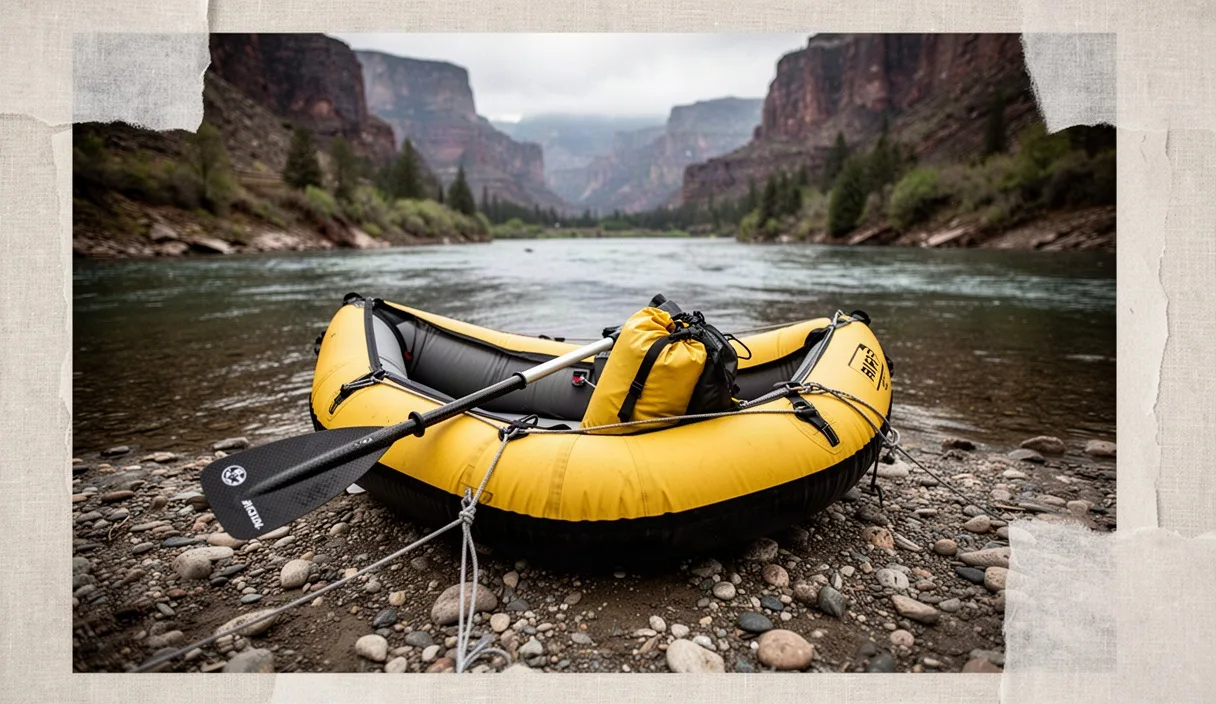
Moving water punishes gear neglect. Packrafting swift rivers requires specialized equipment built to withstand puncture stress, hydraulic force, and cold water immersion. A sub-four-kilo raft behaves differently once hit by cross-currents, boil lines, and downstream loads. Hydrostatic pressure increases exponentially with flow speed, turning a small mistake into an immediate pin or swim.
Every item carried must serve a survival or navigation function. Transitioning from calm flatwater to moving water demands reliable personal protective equipment, clean deck configurations, and an exact understanding of river hydrology. Before paddling moving rapids, strip away surplus camp items and inspect every strap, seam, and seal.
Mandatory River PPE: Helmets, Vests, and River Knives
Personal protective equipment (PPE) is non-negotiable on any river moving faster than walking pace. Whitewater helmets must carry CE EN 1385 certification. Climbing or cycling helmets are unsafe for river running: they feature large front vents that catch rushing water, their foam degrades when saturated, and they lack temporal and occipital coverage against underwater rocks. Look for high-density ABS plastic shells with closed-cell EVA foam liners and drain holes designed to release water instantly when resurfacing.
A whitewater-rated Personal Flotation Device (PFD) must deliver at least 70 Newtons (15.7 pounds) of inherent foam buoyancy. Inflatable PFDs used on flatwater or coastal paddling are strictly prohibited in rapids: an unconscious paddler cannot pull a manual cord, and sharp river rocks shred inflation bladders. Select a low-profile, Type III or Type V vest cut short in the torso to allow clearance over packraft spray decks and high backbands. Ensure the vest fits tightly around the ribs; if someone lifts you by the shoulder straps, the armholes must not slide above your ears.
Fixed-blade rescue knives belong on the outside of your vest on the dedicated lash tab. Select a blunt-tipped or chisel-tipped blade made from high-grade stainless steel (such as 420HC or H1 steel) to prevent accidental puncturing of the packraft or personal drysuit during an emergency. The knife must release from its sheath with one hand via a positive squeeze-lock. Never carry a folding knife in a pocket where it cannot be reached while tangled in rope.
Your rescue kit must also include a dedicated swiftwater throw bag containing 15 to 20 meters of floating 8mm polypropylene or Spectra-core rope. Secure the throw bag inside the cockpit or directly to the seat base with a quick-release cam, never with a closed carabiner. Carabiners used on river runners must be locking, wire-gate clean nose designs to prevent snagging on perimeter lines or safety tethers.
Internal Cargo Storage Systems vs Bow Deck Lashings
Weight placement dictates hull response. Packrafts respond rapidly to paddle strokes when empty, but carrying 15 to 25 kilograms of backcountry gear alters turning speed and stability in waves. Modern packrafts provide two primary payload methods: internal pontoon zippers (airtight TIZIP systems) or top-deck bow lashings.
Internal storage systems place gear inside the air tubes. This lowers the boat center of gravity below the waterline, turning the raft into an extraordinarily stable platform that punches through lateral waves rather than tipping over them. It also maintains a clear deck, eliminating snag hazards that catch rescue ropes, overhanging trees, or paddle blades during rolling maneuvers. However, internal zippers require rigid maintenance. Sand grains inside the zipper teeth break the airtight seal, causing deflation. Lubricate the zipper with silicone paste before every expedition, and pack items into tapered dry bags that slide along the pontoon interior without stretching internal baffles.
Bow deck lashings remain the traditional choice for rapid packing, trail portages, and carrying bicycles during bikerafting expeditions. Lashing items to the bow deck raises the center of gravity, which increases the likelihood of a capsize in turbulent eddy lines. High bow loads also catch upstream winds, demanding heavy paddle correction. If lashing to the deck, keep loads below 30 centimeters in height, strap everything down with redundant cam-locking utility straps, and tape loose strap tails to eliminate entrapment loops.
| Feature | Internal Pontoon Zipper | Bow Deck Lashings |
|---|---|---|
| Center of Gravity | Extremely low; below waterline | High; sits above deck line |
| Capsizing Resistance | High in lateral waves and holes | Moderate to low in cross-currents |
| Snag Risk in Strainers | Zero deck obstructions | High risk of entrapment |
| Water Access to Gear | Requires deflating the boat | Instant access on riverbank |
| Maintenance Demands | High; requires cleaning and lube | Low; standard webbing care |
Identifying Strainers, Sweepers, and River Eddies
River currents run over submerged geography, generating predictable surface hydrodynamics. Reading these features accurately keeps packrafters off riverbed obstacles. Three primary features dominate moving river channels: strainers, sweepers, and eddies.
A strainer is any river obstruction that allows water to pass through while trapping solid objects. Fallen trees, root balls, bridge pilings, and collapsed riprap form lethal strainers. Water creates continuous downward pressure against pinned objects; a paddler trapped against a strainer faces hundreds of kilograms of hydraulic force within seconds. Avoid them early. Give a minimum clearance of two full boat lengths when paddling past riverbanks lined with fallen debris.
Sweepers are low-hanging tree branches that extend across the river channel without touching the riverbed. While they do not act as submerged sieves, they swipe paddlers directly out of their seats, forcing an unexpected swim into downstream hazards. When bearing down on an unavoidable sweeper, tuck your torso flat against the bow spray skirt. Never sit up or raise your hands to push off the limb, as this tilts the upstream tube into the current and causes an immediate roll.
River eddies are areas of slow, reversed, or static water behind obstacles like boulders, canyon walls, or sharp river bends. Eddies provide resting zones and safety harbors. The boundary separating the main downstream flow from the calm eddy is the eddy line. Entering an eddy requires driving the boat across this line with momentum. Execute an aggressive stroke across the shear line and tilt the packraft hull slightly toward the inside of the turn. This lifts the upstream tube edge, preventing the cross-current from grabbing the bottom and flipping the boat.
Wet Exit Drills and Self-Rescue Essentials
Capsize drills must be practiced in calm water before entering Class II rapids. Modern whitewater packrafts often use adjustable thigh straps or internal knee braces to lock the boater into the hull. While thigh straps grant edge control for carving across currents, they increase entrapment danger during an uncontrolled flip.
Follow this exact sequence when a packraft flips:
- Tuck your head toward your chest to protect your face and neck from shallow rocks.
- Release your knees and push downward and outward against the thigh strap release buckles to clear your legs from the boat.
- Place your hands on the pontoon tops and shove the packraft away from your chest as you surface.
- Surface facing downstream with one hand gripping the boat grab loop and the other keeping hold of your paddle shaft.
Once swimming in moving water, transition immediately to the defensive swimming position. Float on your back, pointing your feet downstream with your knees slightly bent to absorb impact against submerged boulders. Keep your butt high in the water column to avoid foot entrapment in river bottom cracks, which can hold a swimmer under current. Your arms should scull wide at your sides to direct your movement across current vectors.
Switch to aggressive swimming only when sprinting to an eddy or escaping upstream of an approaching strainer. Roll onto your stomach, aim your body at a 45-degree angle toward the safety bank, and execute a fast freestyle crawl stroke to punch across the eddy boundary.
For deep-water self-rescue, right the boat by reaching across the upturned floor, grabbing the far pontoon, and throwing your body weight backward. Scramble back into the packraft from the stern or side. Kick your feet to horizontal at the water surface, pull your chest across the pontoon in a single lunging motion, roll your pelvis flat onto the floor, and swing your legs inside.
Pre-Launch River Level and Flow Rate Analysis
Water volume changes river difficulty completely. A river graded as a relaxed Class II run at low water can become a lethal Class IV channel with boiling recirculating holes during peak snowmelt. Before loading gear, check regional streamflow monitors, such as USGS hydrologic stations or national water service gauges.
Measure rivers by volumetric discharge, not simply stage height. Flow volume is recorded in cubic feet per second (cfs) or cubic meters per second (cms). Review historical hydrographs to track the river trend: is the curve rising, cresting, or falling? A rapidly rising river carries detached logs, mud, and debris, while presenting turbulent, muddy boils that swallow packraft hulls. A falling river generally offers clearer water and predictable hydraulic lines.
Calculate the river gradient alongside volume. Gradient is measured in meters per kilometer or feet per mile. A river dropping 2 meters per kilometer with 20 cfs is a slow-moving creek. That same gradient at 200 cfs features pushy wave trains, while a gradient exceeding 8 meters per kilometer creates high-velocity chutes, blind drops, and continuous boulder gardens. Match the measured gradient and current cfs against published guidebook descriptions and local paddler reports before putting in.
Common Mistakes
- Wearing loose clothing: Cotton hoodies, jeans, and loose nylon jackets soak up water, adding dead weight that overwhelms your PFD buoyancy. Wear a proper drysuit with latex gaskets over moisture-wicking fleece.
- Leaving open carabiners on perimeter lines: Non-locking carabiners clipped to boat tubes clip automatically to throw ropes or tree roots during flips, creating an underwater anchor.
- Ignoring foot entrapment risks: Never attempt to stand up in fast-moving water deeper than mid-calf. Riverbed rocks wedge footwear instantly while current folds your body forward under the surface.
- Paddling without scout stops: Blind corners and horizon lines require scouting from shore. Dropping into an unverified drop risks dead-end timber jams or unrunnable man-made weirs.
- Over-inflating cold boats: River water drops tube air pressure rapidly through thermal contraction. Top off tubes with a top-off valve after floating for two minutes. Conversely, vent air immediately when pulling the boat onto hot gravel bars to prevent ruptured baffles.
Immediate Action Checklist
Moving water safety requires ongoing education and tested systems. If you have not practiced wet exits with full gear this season, execute the following steps before your next river route:
First, assemble your river safety kit on a clean tarp: check helmet retention clips, test your rescue knife lock, inspect drysuit gaskets for micro-tears, and repack your throw bag using the clean hand-over-hand method. Discard any throw rope showing core damage, stiffness, or heavy abrasion.
Second, locate an introductory Swiftwater Rescue Course taught by an accredited organization like the American Canoe Association (ACA) or Rescue 3 International. Professional field instruction covers live-bait rescues, entrapment management, and mechanical advantage rigging that cannot be mastered through reading alone. Practice swimming in moving currents under the eye of a qualified safety pro before leading remote trips.